Bilingual Books for Kids: Why They Matter and Where to Start
When my first child was born, I did what most new parents do — I started buying picture books. Lots of them. And like a lot of diaspora parents, I wanted a stack that included books in both languages of our home, English and Shona. I assumed this would be easy. After all, bilingual children's books are a known category. Publishers make them. Bookshops sell them.
What I found instead was that finding the right ones — at the right ages, in the right languages, that I could actually buy and have delivered to the UK — was unexpectedly hard. The shelves were nearly empty for the languages I wanted. The books that did exist were sometimes wrong for my child's age, sometimes poorly produced, and almost always scattered across different sellers in a way that made discovering them feel like detective work.
That experience is, eventually, why Luyana exists. But long before I built a website, I just wanted to read to my child. So if you're a parent at the start of that same journey, here's what I wish someone had told me.
Why bilingual books are worth the effort
It's tempting, when finding books in your other language is hard, to give up and just read in English. I understand the temptation — I felt it too. But there are reasons it's worth pushing through.
Bilingual books act as scaffolding for a child learning a second language. When the English is right there on the page, your child (or you, if you're not fully fluent) can understand the story and use that context to absorb the second language naturally. Without bilingual books, the second language can feel like effort. With them, it feels like reading.
They also do something subtler: they tell your child that their second language belongs in books. For a kid growing up in a country where they almost never see their heritage language written down anywhere — not on signs, not on packaging, not in the school library — that's a quiet but powerful message. The language isn't just for when grandma calls. It's a real language that real authors write real books in.
And, candidly, they let parents who aren't fully fluent participate fully in storytime. I have parts of Shona I'm rusty in. Bilingual books mean I can read the story confidently, with the English as a safety net, while still exposing my child to the Shona words on the same page.
Where to actually start
The advice "look on Amazon" isn't wrong, but it's not helpful either — Amazon will surface the same five generic bilingual books to everyone. Here's what's actually worked for me.
Start with one language, not five. If your family has two languages, pick the one you most want your child to read in and focus there. Spreading across multiple languages early on means you end up with a thin collection in each. Better to have ten good Shona books than two each in five languages.
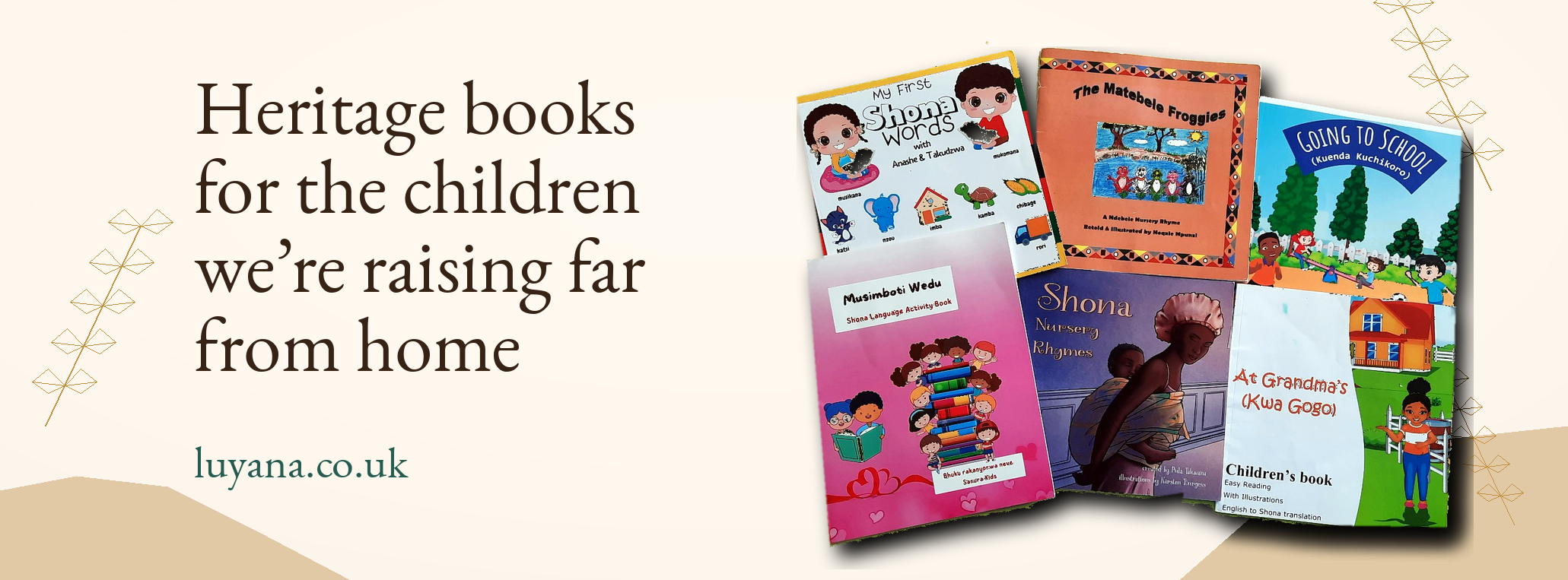
Look for picture books with the same illustrations available in multiple languages. This is one of the most underrated things about bilingual book collections. The same beautiful book in different heritage languages means a kid hears the same story from cousins in different countries — and it's part of what I deliberately curate at Luyana.
Don't underestimate "At Grandma's." The At Grandma's series is genuinely the book I'd hand to any diaspora parent starting out. It's a simple, warm story about a visit to grandmother — and it exists in Shona (KwaGogo), Ndebele (KoGogo), Tonga (Kuli Bakaapa), Lozi (Kwandu yabo Kuku), Chichewa (Kwa Agogo), Swahili (Kwa Nyanya) and English. Same illustrations, same gentle story, eight languages. For a family that wants to honour both sides of a child's heritage, or for cousins growing up across the diaspora, having the same book in everyone's language is quietly magical. (You can find the whole series at Luyana — it's the one I always start parents with.)
Buy for slightly older than your child is now. Books your child can grow into get read more often, and over more years, than books they immediately outgrow. A book bought for a one-year-old that they read until five is a far better investment than one that's perfect now and discarded in six months.
Read aloud, even if your pronunciation isn't perfect. This is the one I had to make peace with myself. Many diaspora parents — especially second-generation parents whose own grasp of the heritage language is partial — feel self-conscious reading aloud. Don't. Your child doesn't care. They want to be read to, by you, in any voice. The pronunciation will improve with practice for both of you.
A short word on where I send people
There are a few places to find bilingual children's books in heritage languages — your local library (genuinely worth asking; some are surprisingly well-stocked, others can order in on request), specialist publishers like Mantra Lingua and Language Lizard, and, in the case of underserved African languages, Luyana itself.
I built Luyana because the books I wanted for my own children were buried under generic search results, scattered across a dozen tiny sellers, and almost never curated by anyone who actually reads them. So if you're looking for books in Shona, Ndebele, Yoruba, Igbo, Swahili, Zulu, Chichewa, or other Southern African languages — that's what I've been trying to make easier. Browse the catalogue here.
The most important thing
Whatever you do, start small and start now. One book, this week. Read it together this weekend. The full library you'll build over your child's whole childhood begins with a single book on a bedside table.
That, more than anything else, is what I wish someone had told me when my first child was born.